
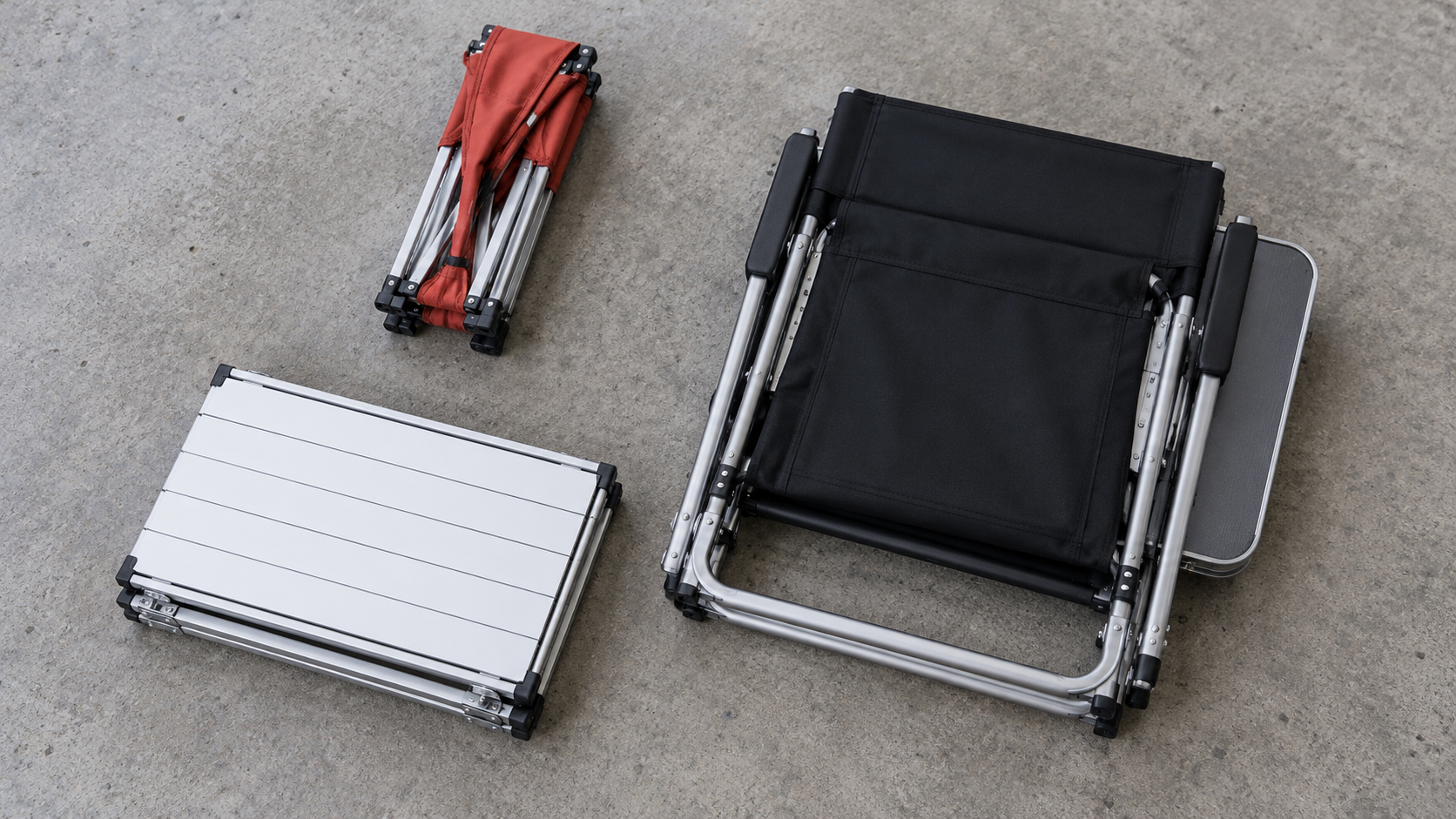
Building a camping assortment is relatively easy.
Building one without tying up too much inventory is harder.
Large retailers can absorb slow-moving products because they have greater sales volume and broader customer traffic. Small businesses often have less room for error.
The objective should therefore be to build a camping selection that covers the most important customer needs while keeping product overlap under control.
Start With the Customer Journey
Think about what happens during a camping trip:
Transport → Setup → Cooking → Lighting → Relaxing → Storage
Each stage suggests different product opportunities.
This gives the assortment a logical structure.
Build Around Core Products
Start with products that customers clearly associate with camping.
Examples include:
- Camping chairs
- Camping tables
- Outdoor lighting
- Cooking products
- Storage
- Bags
- Functional accessories
These products establish the basic proposition.
Add Complementary Products
Once the core products are established, add products that naturally support them.
For example:
Chair + Table + Lighting
creates a basic outdoor living setup.
Similarly:
Backpack + Hydration + Safety Accessories
creates a day-adventure combination.
This is more efficient than selecting products independently.
Watch Product Overlap
Suppose you already have three portable chairs.
Adding a fourth chair that has almost identical functionality may not improve the assortment.
Instead, look for a meaningful difference:
- More compact
- More comfortable
- Different customer profile
- Different price position
- Different outdoor scenario
Every SKU should have a reason to exist.
Use Multi-Use Products
Multi-use products can reduce assortment complexity.
A portable light might be relevant to:
- Camping
- Backyard living
- Road trips
- Vanlife
- Emergency preparedness
A backpack might serve:
- Hiking
- Cycling
- Travel
- Camping
- Everyday use
This allows a retailer to merchandise one product across several collections.
Consider Physical Inventory Characteristics
Camping products are not equally easy to stock.
Bulky products may require more:
- Storage space
- Packaging
- Freight capacity
- Working capital
Compact accessories may be easier to test and replenish.
This does not mean small products are always better.
It means the physical characteristics of the product should be considered alongside its expected sales potential.
Use Samples Before Scaling
Sampling can be particularly valuable when product quality is difficult to judge from photographs.
Check:
- Construction
- Materials
- Dimensions
- Packaging
- Ease of use
- Actual product appearance
A sample is not simply a quality check.
It is also an opportunity to understand whether the product fits your customer and merchandising strategy.
A Simple Assortment Structure
A small camping assortment can be organized into:
Core Equipment
Products that define camping.
Comfort
Products that improve the experience.
Cooking
Products that support meals.
Lighting
Products that improve visibility and atmosphere.
Storage
Products that make transportation and organization easier.
Accessories
Smaller products that complete the assortment.
This structure can remain manageable while still giving customers meaningful choice.
Review Before Reordering
When it is time to reorder, do not automatically reorder every product.
Look at:
- Sales volume
- Customer questions
- Repeat orders
- Cross-selling
- Product returns
- Margin
- Inventory age
The purpose of the first order is partly to learn.
The second order should reflect what you learned.


Leave a Reply
You must be logged in to post a comment.